Showing posts with label moberly. Show all posts

Monday, October 27, 2008

Set an example: Read today

BY JANET STEFFENHAGEN VANCOUVER SUN
The Vancouver Sun
27 Oct 2008


Drop everything and read. That’s what librarians are asking British Columbians to do today at 11 a.m. to mark National School Library Day and deliver a strong signal to children about the importance of literacy. “The message it sends could be so...read more...

_______________________


The BCTLA Conference this weekend in Victoria was fantastic. Michele's thank-you speech was inspiring and would make each one of you proud that she is ONE OF OURS! I have to say, after many years of attending these, I heard not one single complaint about any aspect of this year's conference.

The three fantastic workshops I attended, after a session with the book and resource exhibitors, included Karen Lindsay on reading (the same Karen quoted in the newspaper this morning), Dr Barbara McNeil from U of Regina (on engagement and reading with some of our most reluctant), and Susan Juby of Alice, I Think fame (on being retrieved from the edges by a teacher-librarian who recognized in Susan a young woman with a spark of writing brilliance -- she is now Victoria Public Library's "pet writer"!).

The weather, food, accommodations, and company were also amazing. In other delightful aspects of my weekend, including getting caught in Victoria's annual Zombie March, I must thank Gwen and Sylvia for their help in promoting "promoting the new EBSCO-and-World Book multisector database bundle" -- on very short notice at the BCTLA Chapter Councillors' meeting on Saturday! It is very clear that Gwen loves eLibrary and the Culturegrams as well, and Sylvia uses World Book the most.

DEAR

Speaking of Gwen, our first DEAR report has just come in! Look who's reading today with Moberly students. Gwen emailed:
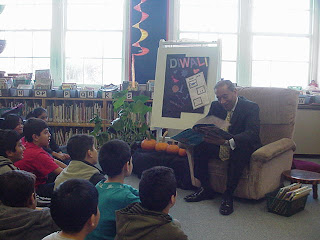

Wally Oppal just became a Friend of the School Library this morning. He also read a book on Divali to a Gr 5 class and talked about the importance of reading every ay. In fact hw suggested they read a novel every two weeks. He will observe DEAR.

Here's news from the mother-ship: Many of our colleagues arrived this morning to find a chocolate bar (thanks, Pat P, for this initiative) from Charlie's that has an attached reminder of National School Library Day and DEAR at 11 am; the chocolate bar reads: sChOOL Libraries -- The Heart (heart-shape) of Literacy. See the word COOL in "school"? I read A Whole New Mind by Daniel Pink, a book I have Sylvia to thank for ... I have tried several times to find it at Chapters.

Here's ESL Betty on the 4th floor preparing to read The Navigator of New York.

This afternoon, Deb Martel, VBE Aboriginal Administrator, and I headed off to the Coalition-sponsored afternoon celebration of Literacy and School Libraries at Carson Graham in North Vancouver. The Honourable Steven Point spoke to students about the importance of reading. Asked by one what reading had made a difference in his life, His Honour quipped, "Mad Magazine"! In a more serious tone, he talked about the gift of a book that influenced his decision to pursue a career in Law; he was given The Story of My Life by Clarence Darrow. Thanks to CG TL Jennifer Teiche and FN Educator Brad Baker for their organizing of this event. The Catering Class had prepared a wonderful spread. Exhibits included carving in progress and displays of an upcoming play written in-house and aboriginal "reads" from picture books to novels and non-fiction. I also enjoyed the afternoon of chatting with CG administrators Steve Garland and Ray Bodnaruk, as well as North Van TLs Felicity Eadon, Shelagh Martin, and Marilyn Aldworth ... oh, and commenting on the really good food with His Honour. What a treat to be invited.

From the Carson Graham website:

“This is a wonderful opportunity for so many of our students to meet such an inspiring and accomplished person,” says Jennifer Tieche, learning resource/teacher-librarian at Carson Graham. “The Lieutenant Governor embodies the pursuit of learning and appreciation of literature we encourage with our students.”

“We are grateful for this opportunity to showcase the importance of high-quality school library programs,” says Kathryn Shoemaker, chair of the B.C. Coalition for School Libraries. “National School Library Day honours the connection between student success and the essential work of school libraries to promote the freedom to read, foster inquiry and further knowledge.”


DEAR Press Release Today:

PRINCE GEORGE - Education Minister Shirley Bond celebrated National School Library Day Oct. 27 by taking part in the Drop Everything and Read challenge, issued by the B.C. Teacher-Librarians' Association.

"Our family loves to read and has always made it a priority. I am happy to 'drop everything and read' to celebrate national school library day," said Bond. "I have also invited my colleagues around the province to do the same thing."

B.C.'s teacher-librarians challenged everyone in the province to Drop Everything and Read for 20 minutes at 11 a.m. today.... "It's about encouraging young people to read and value literacy," said Karen Lindsay, vice-president of the B.C. Teacher-Librarians' Association. "Studies clearly show that daily silent reading improves vocabulary, spelling, comprehension and much more."

"It is also important to say thank you to teacher-librarians and other educators who work so hard to ensure our students develop a love of reading and excellent literacy skills," said Bond.

Hope you enjoyed today ... and, as DEAR unfolded at the VSB, there was great excitement all across the province as word spread about new ways this initiative was developed or promoted in BC. DEAR has really taken off this year, and we want to hear what your school has done to celebrate National School Library Day. You can report your school's activity using the comment function below (that would be the best use of this Web 2.0 tool) or email me!

Friday, March 28, 2008

Delicious Links

WWW / Working With Wikis

Researchers Build a Wiki at Moberly

This blog is being written today (Thursday afternoon) at-the-scene, live from the school library where I have been invited to help grade 7 students get started on their wiki assignment. They are going to build pages for the whole-class project -- a wiki -- on Ancient Greece. Students will research subtopics in pairs and create a report with images on pages linked to the wiki-assignment page. They have recently been introduced to and are using del.icio.us to collect the best websites for their research. They will use pbwiki to publish their work.

The product is emerging at: Ancient Greece. You will need to click on Sidebar to see the linked student-project pages.

Teacher Ms J is happy to see the students enabled by the technology to use both their creativity and their learning to create new products such as wikis. She appreciates the engagement that such assignments offer her students.


On seeing that the students are happily and fully engaged, that they are easily helping each other venture into the world of wikis, that they don't really need my expertise at all, I have found a computer, opened up this blog, and am about to interview a few of the participants to capture the "feel" of this learning experience.

The teacher is Ms J. She tells me, without hesitation,"This is the future, the new literacy that they will need to develop and understand .... It's great to see them taking steps that will help them in their futures." Ms J has been teaching for three years and is currently doing a master's degree in Language and Literacy Education. She recently took a UBC course, the same one taken by "our Mary," called The New Literacies with Instructor Dr. Marlene Asselin. She loves working with Gwen, the TL, and sees how Gwen is always looking ahead. Clearly Gwen and Ms J are deeply exploring Web 2.0 with their students.

So what do the students think of this learning experience?
  • Student Monica finds that it's faster, neater, easier to use, new, and fun to learn this way. It is something you can use on your own and when you're older. She has been here at Moberly since Kindergarten and always likes coming to learn in the library.
  • Suchjot finds it interesting to learn something new about the internet; it's "portable," she says, "so you can use it anywhere on-the-go." Suchjot thinks it's a much better way to learn because you can add and others can too, and everyone can build it and learn from it. Suchjot's words, colleagues ... can you imagine this!
  • Harveer adds that it's cool making your own webpage; if you travel you won't have to use (or risk losing) your flashdrive because you have a wiki you can post to. It's interesting to learn new things -- the first time (learning these new and useful tools in the library) is always a privilege, he tells me. He says it's better working with the teacher and the teacher-librarian together because they know a lot of different things and it's always nice to work on the computers.
Thanks, Moberly, for the invitation! You are inspirational.

Linking Delicious Things

In keeping with Wendy C's Hot Reads talk at the February Winter Tonic where several recommended novels and mysteries included recipes, I have been meaning to include some too, yours, not mine. Tillicum-visiting with TL Sharon just before the Break yielded her wonderfully and delicious recipe for chocolate, and it's really easy -- or so she says:


Tiger Butter

3 cups white chocolate dipping wafers
½ cup milk chocolate dipping wafers
2/3 cup smooth or crunchy peanut butter

  • Microwave white chocolate wafers slowly until melted (3-4 minutes in one minute intervals).
  • Add peanut butter and beat until mixed.
  • Spread on waxed paper to 1/8” thickness.
  • Microwave milk chocolate until melted (1 minute on high).
  • Spoon milk chocolate onto the white chocolate in rows 1-2” apart.
  • Drag a knife or tip of a spoon gently across the rows to form the pattern.
  • Air dry until hard and cut into 1” squares.
TIP - I had to ask about the chocolate "dipping wafers"; they are about the size of a nickel and are available in the bulk foods section of Save-on Foods. Sharon's Tiger Butters were perfectly peanutty squares of chocolate about the size of AfterFive Mints.
NOTE: Thanks, Barb McB and VP Darren at Tillicum for the invitation to your lovely school, and thanks, Sharon, for the tour and recipe. I am so impressed with this little annex and its lovely large library, Smartboard, lab, and program of technology integration, that I am planning to have the May Update session for Annex TLs here. We can call it "On the Urban Edge" as you will need to plan to travel to the Far Eastern reaches of our city. We are working out a date for this. Can you let me know which day of the week would be best (you can email me)?

Technology-Integration / Linking Readings for Deeper Consideration

Edutopia is a great website for keeping up with technology integration. Underpinned by the awareness that social change is faster-paced than ever before, the George Lucas Foundation envisions a new world of learning, an education system where innovation is the rule, not the exception ... well, you can read this by clicking onto the "about us" page. But there are some great articles to be considered from amongst the Priority Topics. I offer this suggestion as a starter:

Adopt-and-adapt: shaping tech for the classroom by Marc Prensky (or, 21st century schools need 21st century technology). Prensky (2005) posits the notion of "digital immigrants" and "digital natives." Many of us, he would suggest, are the "conservators" of our culture and are resistant to change but resisting today's digital technology "will be truly lethal to our children's education"! He's pretty provocative, is Prensky, and I actually don't agree with him.

Here's what I think: Learning anything new takes time ... something many of us in education don't have a lot of ... and there is heightened anxiety attached to our "adult" learning about technology that needs to be acknowledged. We need not be viewed as "immigrants" but as students on the learning continuum who need to be "scaffolded" across the points of frustration.
Not immigrants, but learners, we are also educators steeped in critical capacities that enable us to offer students the thinking skills as our part of the technology-learning equation where often they are the teachers. Certainly their sense of adventure in the technological learning environment is what leads us on ... but this is not a colonial enterprise; it's a partnership where our relationship to what is being learned has changed. We have not changed who is the expected master or authority for learning and who is the "slave" or obedient recipient of knowledge, but rather we are seeing a flattening of the leadership roles -- a blurring of the boundaries or borders -- in relationship to acquiring and transforming knowledge. We are all required to become lifelong learners. The statement about the importance of being a lifelong learner is not just for our students. We are not "behind" our native students trying to catch up but rather "beside" them bringing different capacities to the collaborative learning experience.

How's that for an analysis? And Ms J and her students are right: every student needs to leave school knowing how to do these things and how to think about them.

You will undoubtedly want to read more from the Edutopia Priority Topics page. Here's Prensky's (Feb 2008) concept of literacy explained. Prensky is a little too techno-bedazzled in his thinking for me, but it's a great place to start in considering your own place and the place of your school library program, as well as district directions for school libraries in relation to these ideas.

Check out the free Edutopia teaching modules too.

Here's a great article: "U.S. educators seek lessons from Scandinavia High-scoring nations on an international exam say success stems from autonomy, project-based learning," by Meris Stansbury, Assistant Editor, eSchool News. I thought it advisable not to ask about the recent e-testing! Abstract for the article reads: "A delegation led by the Consortium for School Networking recently toured Scandinavia in search of answers for how students in that region of the world were able to score so high on a recent international test of math and science skills [PISA]. They found that educators in Finland, Sweden, and Denmark all cited autonomy, project-based learning, and nationwide broadband internet access (emphasis mine) as keys to their success."
Thanks, again, Moberly and Tillicum too: you've got us thinking! You are engaged in cutting-edge learning.