Guest Blogger: Anthony Horowitz
Dear Mr Horowitz: In the UK, your fellow authors Pullman and Rosen are lobbying for the reclamation of school libraries in British schools. Perhaps, just perhaps, the deplorable reading skills and lack of reading interest of the young people in the UK today noted in your blog post are directly related to the absence of or under-investment in school libraries and teacher-librarians. Our students love your books, by the way!
Yours truly,
Moira
Showing posts with label reading. Show all posts
Showing posts with label reading. Show all posts
Tuesday, March 1, 2011


Saturday, January 1, 2011
The Future of Reading
Good reading to get ready for 2011 in school libraries:
A series of recent LA Times articles explore new directions for reading, digital books, the publishing industry, and libraries: The future of Reading - latimes.com (Thanks for this link, Mark!)
Happy New Year!
A series of recent LA Times articles explore new directions for reading, digital books, the publishing industry, and libraries: The future of Reading - latimes.com (Thanks for this link, Mark!)
Happy New Year!
Friday, December 10, 2010
Am I Harping? It’s a Seasonal Thing!
On the Importance of Reading:
Insights from some of my earlier blog posts (search Krashen) serve as a reminder that school libraries provide an important piece in a balanced approach to literacy development; we after all provide the quality books and online sources that enable reading widely for knowledge, freely for interest, and deeply for understanding.
The recent results of the PISA 2009 testing of 15-year olds around the world offer the chance to reconsider the research presented here before. I am reminded of the metaphorical question Dr. Stephen Krashen asked at a conference I attended in California one summer: What if there was a country experiencing a drought and famine, and the experts deemed that the children there needed painful and expensive surgery? Everyone would say: “No, feed them!” Similarly, children don’t need painful and expensive intensive phonics programs or more testing, they need books!
A noted and frequently cited expert on the importance of free voluntary reading for children’s literacy development and also on second language learning, Krashen told the audience that there are three things that keep the mind supple: bilingualism, reading, and coffee! This was a man I knew had important things to say. Krashen's most significant finding? "Children are more likely to read if they have something to read."
Krashen thought his talk should be entitled, "How Libraries Can End All Literacy Issues Forever." He continued: The most powerful tool in the literacy kit, supported by consistent research, is free voluntary reading. It is Krashen's view that school libraries are the hottest area in language and literacy education. The better the school library, the higher the reading scores. His talk was referenced to other signficant milestones in understanding the power of reading:
I began teaching in the days when Hooked on Books was what we knew to be true – now is a good time to ask, just how and why has the BC education system has been led so far astray, with a 26% reduction in the ranks of teacher-librarians since 2001, and at what costs to school libraries and our students as lifelong readers? Be sure to include a book in your child’s gifts this holiday season. See the VSB website for reading suggestions from Vancouver teacher-librarians. See your teacher-librarian about becoming a Friend of School Libraries in Vancouver.
Insights from some of my earlier blog posts (search Krashen) serve as a reminder that school libraries provide an important piece in a balanced approach to literacy development; we after all provide the quality books and online sources that enable reading widely for knowledge, freely for interest, and deeply for understanding.
The recent results of the PISA 2009 testing of 15-year olds around the world offer the chance to reconsider the research presented here before. I am reminded of the metaphorical question Dr. Stephen Krashen asked at a conference I attended in California one summer: What if there was a country experiencing a drought and famine, and the experts deemed that the children there needed painful and expensive surgery? Everyone would say: “No, feed them!” Similarly, children don’t need painful and expensive intensive phonics programs or more testing, they need books!
A noted and frequently cited expert on the importance of free voluntary reading for children’s literacy development and also on second language learning, Krashen told the audience that there are three things that keep the mind supple: bilingualism, reading, and coffee! This was a man I knew had important things to say. Krashen's most significant finding? "Children are more likely to read if they have something to read."
Krashen thought his talk should be entitled, "How Libraries Can End All Literacy Issues Forever." He continued: The most powerful tool in the literacy kit, supported by consistent research, is free voluntary reading. It is Krashen's view that school libraries are the hottest area in language and literacy education. The better the school library, the higher the reading scores. His talk was referenced to other signficant milestones in understanding the power of reading:
- Daniel Fader's Hooked on Books revolutionized how educators delivered reading programs in schools and school libraries. Dr. Fader had successfully demonstrated in his study of underprivileged boys that, given books and freed from writing reports or paying fines, they were better at everything -- simply by administering "books" and time for independent reading.
- The 1983 work of Elley and Manghubai, "The effect of reading on second language learning" (Reading Research Quarterly, 19:1, 53-67), now known as the Fiji "Book Flood" project, demonstrated that students in grades 4 and 5, immersed in regular reading of English materials as part of their second language learning experience, showed accelerated development of their second language proficiency in reading and listening but also had consistent and positive improvements in their proficiency in their own language as well.
- The "book flood" project was replicated in 1985 in Singapore with a larger number of younger children; the results were consistent with the earlier findings: children in the study group did better than those taught by traditional methods on tests of reading comprehension, vocabulary, oral language, grammar, listening comprehension and writing. Elley noted that children exposed to a broad choice of high-interest, illustrated story books who are encouraged to read and share them will learn a new language more quickly but there will also be improved competence in other language skills such as writing and control over syntax. That is, all language skills are improved by reading as opposed to learning the language from textbooks with reading programs. Additionally students do better on tests when they read, through acquisition, than when they are taught for testing. Or, literacy and language development should be pleasurable experiences, not painful ones.
- When programs such as Accelerated Reader which put books, time to read, tests and quizzes of literal understandings together with prizes, Krashen suggested, conservatively, there needs to be a definitive study; but, he continued, one might also conjecture that such programs are, in fact, harmful because they offer extrinsic rewards for something intrinsically pleasurable. Alfie Kohn offers this same point in his book Punish by Rewards: payment for something you like to do can "extinguish the behaviour."
- A longitudinal study by Greaney and Clarke (1973) showed that boys who engaged in sustained silent free reading in school continued to be readers as adults.
- The practice of reading aloud with children underpins Jim Trelease’s book The Read-Aloud Handbook (2006, Penguin). Trelease observes the importance of what he calls the "home-run" books, the books that make a difference in a child's life with reading, be that Captain Underpants or Garfield. These are the keys into literature, into fictional expressions that portray life experiences, ethics, and more.
- Frank Smith adds that children read more in quiet comfortable places with lots of books, that they get the "feel" for stories from read-alouds like Charlotte's Web and Judy Blume.
- The relationship of higher achievement to the presence of strong school library programs is supported by the research of Lance and Loertscher and by the work of Jeff McQuillan, in his book The Literacy Crisis: False Claims, Real Solutions (Heinemann, 1998). McQuillan used data from the NAEP (National Assessment of Educational Progress). Unlike standardized testing, the NAEP is zero-stakes and uses only a sampling of students. Controlling for poverty, McQuillan found there were better results with better access to libraries. There is a strong correlation between access to print materials and reading scores, supporting the case for strong, well-stocked libraries.
- These results are replicated in a study of 2007 NAEP scores. Researchers undertook to assess the impact of access to books on two groups of children equally poor. The one with access to books will do better. They assessed predictors of improvement by grade 8 and found the single factor was access to books.
- The PIRLS (Progress in International Reading Literacy Study) provides plentiful data about the students who are tested in 40 different countries. Again data indicates reading instruction is negative and the effect of poverty is overwhelming. There is more likelihood that children in high income neighbourhoods will have a qualified teacher-librarian, access to materials, reading services, and bookstores.
- Barbara Heyns shows that high and low income children show the same gains throughout the school year. The difference is made in summer reading where students of higher socio-economic status are more likely to live closer to the library and use it. Summer reading programs provide opportunities for two hours of reading a day, 30 minutes a day for browsing, and time for talking about what is being read. The single most popular author for young readers? R L Stine!
I began teaching in the days when Hooked on Books was what we knew to be true – now is a good time to ask, just how and why has the BC education system has been led so far astray, with a 26% reduction in the ranks of teacher-librarians since 2001, and at what costs to school libraries and our students as lifelong readers? Be sure to include a book in your child’s gifts this holiday season. See the VSB website for reading suggestions from Vancouver teacher-librarians. See your teacher-librarian about becoming a Friend of School Libraries in Vancouver.
Friday, October 8, 2010
The Sorry Decline of Picture Books
Publishers are scaling back on picture books as more parents favor text-heavy chapter books for their young children.
Sunday, September 12, 2010
VSB READS ... and reads and reads and reads!
ON READING (was there any doubt?)
Thanks to Maryann for keeping an eye out for the stats that show just how good we are! If you read her MLST annual report, you will notice we discarded well over 100 000 dusty volumes from our various collections. BUT more significantly, we have again generated significant district circulation numbers of 1.7 million items in the 10-month school year, OR, put another way, we have the 10th highest annual volume of circulation of all libraries in the province, ahead of Coquitlam, West Vancouver, and the Thompson-Nicola Valley Regional public libraries! Imagine that. Keep 'em reading and researching with VSB resources in our school libraries, I say! Keep up the truly excellent work on the front lines of service delivery.
Dr Renee Norman, VSB Primary Literacy Consultant, and I participated in YSL 4: Reading, an international online school library conference, as hosts of a discussion on reading. We agreed: quality literature experiences and enabling adults, including teacher-librarians, are key to making reading meaningful and pleasurable for children and young adults. We have high school libraries so crowded at the breaks that crowd control measures are required ... these are the reading young people who will return to the public libraries as adults; we have elementary schools that circulate over 100 books per child per year. There's unequivocal proof that Vancouver students are readers. I was also the moderator of the session featuring Dr Stephen Krashen ... he's one of two of the world's leading experts on reading, along with Aidan Chambers, whose work I think so significantly underpins the work we do as TLs. Wasn't I happy to be asked!
We have moved into a world of e-reading possibilities. We are moving into e-texts in the district. Children who pour over computers are reading. Research shows that reading anything improves reading! And vocabulary, grammar, syntax, and so on ...
National School Library Day is Monday, October 25, this year; it is celebrated in our district with the BCTLA's Drop Everything and Read campaign, 20 minutes at 11:00 am on that day. On the Tuesday evening, parents and district teachers, trustees, and management are invited to hear a speaker ... TBA. Book these dates.
Michele sends you this youtube link: Teaching Content is Teaching Reading. Don't forget that any learning that contextually embeds learners' deep thinking with words, text, and image is developing important student literacies.
I spent Friday night at an annual Bar-B-Q dinner with the VTLA Executive. The evening took on a whole new fevered pitch of excitement when the topic of reading and great new books came up. There was keen energy to get back to putting hot new titles and fantastic new books onto the wiki. If you would like to be able to "write" in your suggestions, along with the heavy reading Jan, Mary, Gwen, and others, you can simply go to the wiki and request permission. I will activate you and send you the password. The TL Special Wiki is pbworks (as easy as a peanute butter sandwich -- pb, get it? --so it's easy enough for anyone ... WYSIWYG entry of data. We will have a chance to work on this at our Updates. See you there ... bring your favourite new titles.
Learning Commons / Refreshing Our Profile
Some amazing transformations have been happening in our school libraries. Often these re-transformed spaces seem to have emerged after a visit from Wendy usually accompanied by Linda. Wendy and Linda were the guest presenters for new TLs last week. Check out the Picasa volume that speaks and highlights volumes in new and attractive ways. Thanks are due to these amazing TLs whose spirit and mentoring has been so compelling for me and for others. Now I am wondering how you do with cubicles!
There are a number of school libraries as well facing seismic upgrades, including JQ, Douglas, General Gordon, Kitchener, U Hill, and Kitsilano. With US-based award-winning educational architectural consultants Randall Fielding and Prakash Nair on our VSB team, there are fantastic opportunities to transform more than the facility. In fact, the YSL 3: Designing School Libraries conference offered the notion that first you must tranform the teaching and learning. This year I facilitated the Kitchener Teacher Inquiry with Lisa Pedrini. Now there's a team putting the conceptual, spatial, and pedagogical together and "constructing" new ideas and ideals for what will take their students well along the continuum of learning for the 21st century. It's all a little unsettling ... in a good way, don't you think!
Have a good week, everyone.
Building our Community
The Vancouver Teacher-librarians' Association (VTLA) will have its Annual General Meeting later this month. There is a call for new faces at the meeting and on the Executive. We have had one key retirement this year, Pam, who was most important as an organizer of Winter Tonic. That's a great role for someone with new contacts and ideas.
The BCTLA Conference is in Kelowna on October 22: Kelowna Fresh. That's going to cost you $190, including your PSA membership. Some or all is reimbursed by school Pro D funding. There are to be three keynote sessions. I am finally going to get to hear Dr Jamie McKenzie. Carlene Walter (50 Ways to Love Your Library) and Donna Desroches are coming from Saskatchewan. And Dr Art Hister will be speaking too. Carpooling and room-sharing will be items on the email discussions soon.
Thanks to Maryann for keeping an eye out for the stats that show just how good we are! If you read her MLST annual report, you will notice we discarded well over 100 000 dusty volumes from our various collections. BUT more significantly, we have again generated significant district circulation numbers of 1.7 million items in the 10-month school year, OR, put another way, we have the 10th highest annual volume of circulation of all libraries in the province, ahead of Coquitlam, West Vancouver, and the Thompson-Nicola Valley Regional public libraries! Imagine that. Keep 'em reading and researching with VSB resources in our school libraries, I say! Keep up the truly excellent work on the front lines of service delivery.
Dr Renee Norman, VSB Primary Literacy Consultant, and I participated in YSL 4: Reading, an international online school library conference, as hosts of a discussion on reading. We agreed: quality literature experiences and enabling adults, including teacher-librarians, are key to making reading meaningful and pleasurable for children and young adults. We have high school libraries so crowded at the breaks that crowd control measures are required ... these are the reading young people who will return to the public libraries as adults; we have elementary schools that circulate over 100 books per child per year. There's unequivocal proof that Vancouver students are readers. I was also the moderator of the session featuring Dr Stephen Krashen ... he's one of two of the world's leading experts on reading, along with Aidan Chambers, whose work I think so significantly underpins the work we do as TLs. Wasn't I happy to be asked!
We have moved into a world of e-reading possibilities. We are moving into e-texts in the district. Children who pour over computers are reading. Research shows that reading anything improves reading! And vocabulary, grammar, syntax, and so on ...
National School Library Day is Monday, October 25, this year; it is celebrated in our district with the BCTLA's Drop Everything and Read campaign, 20 minutes at 11:00 am on that day. On the Tuesday evening, parents and district teachers, trustees, and management are invited to hear a speaker ... TBA. Book these dates.
Michele sends you this youtube link: Teaching Content is Teaching Reading. Don't forget that any learning that contextually embeds learners' deep thinking with words, text, and image is developing important student literacies.
I spent Friday night at an annual Bar-B-Q dinner with the VTLA Executive. The evening took on a whole new fevered pitch of excitement when the topic of reading and great new books came up. There was keen energy to get back to putting hot new titles and fantastic new books onto the wiki. If you would like to be able to "write" in your suggestions, along with the heavy reading Jan, Mary, Gwen, and others, you can simply go to the wiki and request permission. I will activate you and send you the password. The TL Special Wiki is pbworks (as easy as a peanute butter sandwich -- pb, get it? --so it's easy enough for anyone ... WYSIWYG entry of data. We will have a chance to work on this at our Updates. See you there ... bring your favourite new titles.
Learning Commons / Refreshing Our Profile
Some amazing transformations have been happening in our school libraries. Often these re-transformed spaces seem to have emerged after a visit from Wendy usually accompanied by Linda. Wendy and Linda were the guest presenters for new TLs last week. Check out the Picasa volume that speaks and highlights volumes in new and attractive ways. Thanks are due to these amazing TLs whose spirit and mentoring has been so compelling for me and for others. Now I am wondering how you do with cubicles!
There are a number of school libraries as well facing seismic upgrades, including JQ, Douglas, General Gordon, Kitchener, U Hill, and Kitsilano. With US-based award-winning educational architectural consultants Randall Fielding and Prakash Nair on our VSB team, there are fantastic opportunities to transform more than the facility. In fact, the YSL 3: Designing School Libraries conference offered the notion that first you must tranform the teaching and learning. This year I facilitated the Kitchener Teacher Inquiry with Lisa Pedrini. Now there's a team putting the conceptual, spatial, and pedagogical together and "constructing" new ideas and ideals for what will take their students well along the continuum of learning for the 21st century. It's all a little unsettling ... in a good way, don't you think!
Have a good week, everyone.
Building our Community
The Vancouver Teacher-librarians' Association (VTLA) will have its Annual General Meeting later this month. There is a call for new faces at the meeting and on the Executive. We have had one key retirement this year, Pam, who was most important as an organizer of Winter Tonic. That's a great role for someone with new contacts and ideas.
The BCTLA Conference is in Kelowna on October 22: Kelowna Fresh. That's going to cost you $190, including your PSA membership. Some or all is reimbursed by school Pro D funding. There are to be three keynote sessions. I am finally going to get to hear Dr Jamie McKenzie. Carlene Walter (50 Ways to Love Your Library) and Donna Desroches are coming from Saskatchewan. And Dr Art Hister will be speaking too. Carpooling and room-sharing will be items on the email discussions soon.
Friday, June 25, 2010
Summer Reading Suggestions
Just4U: Adult Summer Reading
The Walrus: Pick up and carry in your beach bag a copy of the July/August issue of The Walrus: it is "the only mass magazine in the country that publishes fiction in every issue .... The Summer Reading Issue will bring you the work of nine Canadian writers (“Canadian Studies,”) who were given a simple challenge: write a truly Canadian short story" (from Editorial by John Macfarlane).
NOTE: Zsuzsi Gartner, one of our wonderful FOSL reps whom we recognized with an award at our VTLA year-end dinner, crafted the response that spoke for school libraries during the recent VSB budget process. Her story, "Say the Names," is included in this issue of The Walrus. We can feel very privileged to have her speaking for Vancouver's school libraries.
Canada Reads: This year's book is Nikolski by Nicholas Dickner, translated by Lazer Lederhendler. But you could choose any one of the selected titles, including Good to a Fault, by BC writer Marina Endicott; Generation X by Douglas Coupland; The Jade Peony by Wayson Choy; and Fall on Your Knees by Ann-Marie MacDonald, if you were looking for good Canadian fiction but didn't feel compelled to join in by reading the cross-country summer book choice.
Indigo's Top 100 List: choose one from the list of best books as determined in an online survey of Canadian readers in 2007.CBC suggests you listen to the Between the Covers audio reading of Nikolski and check out the CBC Book Club's celebration of Nikolski. And join host Hannah Sung and other book lovers in the Book Club all year long.
Project Gutenberg's Top 100 eBooks: a list based on downloads
The Bookmark: The June 2010 (50:2) issue of this BCTLA tradition is now online and it's free! What are Living Libraries? What's New on the Net? How do you get a teen book club going? What's this about "convergence or confusion" about eBooks? What's worth reading in YA and children's literature? The answers are all here for your summer enjoyment.
VPL Digital Resources: now includes Best of BC Books Online; use your VPL card to access this pilot project of 1000 ebooks published in BC.
VPL Book Clubs: there's one for every reading and social need -- Reel Reads, World Authors, Online, Drop-in, Poetry, Summer Reading, One Book: One Vancouver -- or find out how to start your own.
Or plan to attend one VPL event this summer: the Book Lovers' Reading Circle starts July 3 and the Summer Book Sale is July 8.
VPL Recommends: Fiction &Literature (for Adults) offers loads of lists, including Staff Picks (June 2010). Something for every taste! If you prefer lists of recommended non-fiction, check here.
The list of lists of Fiction & Literature is long, including but not limited to Award Winners, Banned Books, Canadian Mysteries, CanLit, Delectable Reads, Historical Fiction, Graphic Novels for Adults, Books Made into Movies, Life in Venice, Lusty Reads, Reading the City Series: Vancouver is for Readers, Manly Fiction, Vancouver Fiction, and Women’s Fiction.
4them: Kids and Summer Reading
TD Summer Reading Club: Destination Jungle
This online reading club is sponsored by TD, the Toronto Public Library, and Library and Archives Canada, its goals are to encourage and strengthen the habit of reading for pleasure to create life-long learners, as well as to increase children's reading skills and reduce summer learning loss.
VPL Summer Reading Club: Children ages six to twelve are invited to join the Reading Rocks! Summer Reading Club. Vancouver Public Library also invites school age children to join the Multilingual Summer Reading Club - read books in any language!
Chris Tougas, author and illustrator of Art's Supplies and Mechanimals has created the hilarious poster and reading record for Reading Rocks! Summer Reading Club. Members will receive a reading record, bookmark, and stickers to collect. Children can record the titles and authors of the books they read on the reading record. It's lots of fun and absolutely free!This summer reading initiative is sponsored by the British Columbia Library Association and the Vancouver Public Library, with the assistance of the Public Library Services Branch, Ministry of Education.
VPL’s Summer Writing and Book Camp: Got the Write Stuff (August 9-13) is for 11-13 year olds and for 14+. It’s FULL already but there is a waiting list.
Keynotes include well-known YA authors Carrie Mac, Sarah Ellis, Polly Horvath, Susan Nielsen, and Meg Tilly. Also working with young writers and readers will be Maggie de Vries and Julie Burtinshaw. Get your teen or pre-teen writer on that waitlist now! This extremely popular summer camp is a bargain for $225. If you can't get your teen or pre-teen in this year, remember to look for this earlier next year.
VPL Recommends: Kids & Teens
Check out the great lists for your reading kids and teens.
Wednesday, June 9, 2010
YSL4: Reading 2010
Some of us are now in attendance at the Reading 2010 YSL4 online conference where Dr Stephen Krashen, best known for his work on the importance of free voluntary reading, is a breath of fresh air in challenging the notions of reading that have underpinned the grand-scale initiatives to improve literacy in North American. I have introduced his interactive dialogue session, which I have the privilege to be moderating, as follows:
Wish you were there to read the world responding and to contribute. The irony is being felt here in Vancouver school libraries -- and elsewhere in BC -- in gut-wrenching ways. We thank you, Madame Minister of Education, for insights into ways to cut costs in education but the real social costs mean we are putting at risk the futures of our less privileged children in ways that are huge and life-changing. There is a strong correlation between juvenile delinquency and low literacy development, or so Jamie Graham, former Chief of Police here in Vancouver, and others would have us believe. There is a strong correlation between literacy development and poverty that is offset by there being strong, well-suppported school library programs that offer children choice in what they read. Or so Stephen Krashen would have us believe. I believe! Do you?
Krashen references his work [on reading] to signficant milestones in understanding the power of reading. His talks essentially provide support for ways that libraries can end all literacy issues forever. The most powerful tool in the literacy kit, supported by consistent research, is free voluntary reading .... Yet, ironically, even as, in Stephen's words, "We now have the best evidence we have ever had on the value of libraries and ... of recreational reading, libraries and free reading have never been in more trouble."
Wish you were there to read the world responding and to contribute. The irony is being felt here in Vancouver school libraries -- and elsewhere in BC -- in gut-wrenching ways. We thank you, Madame Minister of Education, for insights into ways to cut costs in education but the real social costs mean we are putting at risk the futures of our less privileged children in ways that are huge and life-changing. There is a strong correlation between juvenile delinquency and low literacy development, or so Jamie Graham, former Chief of Police here in Vancouver, and others would have us believe. There is a strong correlation between literacy development and poverty that is offset by there being strong, well-suppported school library programs that offer children choice in what they read. Or so Stephen Krashen would have us believe. I believe! Do you?
Saturday, May 22, 2010
I Love the Colour of It All
Week 2: The Last Chapter, continues:
Through Castles and Jungles ... and More
The Sacred Places of Reading in the VSB
As many of you know, Maryann and I "hit the road" for most of May, taking our unfortunately-named May or year-end Update session -- The Last Chapter -- out to schools. The schedule at the moment is unrelenting ... and it isn't over. Add job-hunting and tackling the annual backlog of work to the package and I am sure you can appreciate that I arrive as required! Thanks for your beautiful spaces and kind thoughts, and thanks, MK, for taking over the snacks and other details that are all seeming a little overwhelming. I choose to blog it all out for therapy!
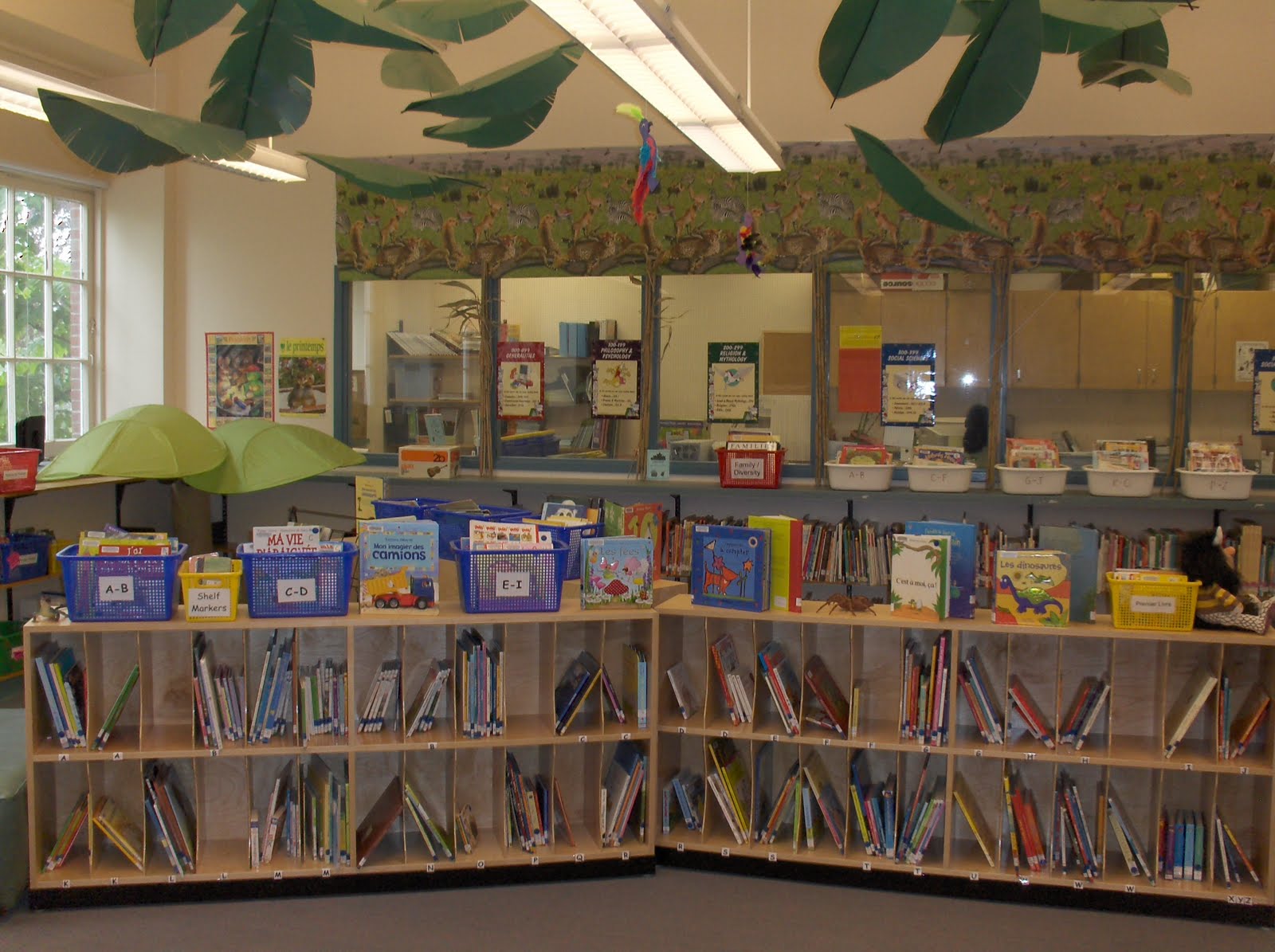 It's a jungle out there at Selkirk
 Can you believe this?
An administrator is as excited about this "reading space"
as are the TLs here.
 The Reading Chamber: Selkirk makes it all fun!
And on to Dickens:
 You have to love the colour here
at Dickens
 And quilt-art for the walls
 We went to Henderson and found this:
 Here's the art from our Carnavale:
 We are in awe of Shaughnessy
 Where the reading space feels almost sacred
 Kids read online at Gladstone:
 The garden fairy reads too:
 And at Van Tech, there are miles of books to read ...
  and new ones too:
 The Last Chapter, continues next week:
 After Castles and Jungles ...
What More Can There Be?
Tuesday, May 18, 2010
TLs Rock ... and so do their kids
While on the indie-rocking theme (see previous posts), I have discovered I am not alone. One mother-TL knew what radio station I listened to from my description and sent me this clip of her son's band.
Check out ELIAS on MTV (you will have to skip through the ads) ... and then you can guess which TL-mother belongs to the red-headed guitarist.
Here you will see the band singing about being "drop out" kids. Of course, we know that this is where so many social problems associated with a "stripped" education begin, most often cut short because it has failed to engage, missed the chances to capture the imaginations and stimulate the creativities and talents of our youngest citizens, blown the places where it could respect their differences or valued their uniqueness.
These young and talented up-and-coming Vancouver-based performers got their start in school music programs; they know the value of strong school library programs because one has a TL-mother who is a constant and unrelenting advocate for high-quality SL programs. "Dropping out" is what happens when you strip a school system of its capacity to engage its young -- in reading, in music, in the arts, and in meaningful and relevant learning experiences.
School libraries are places that attend to the affective piece of the learning experience. You will see in the current blog entries the substantial investment Vancouver has made in literacy, in inspiring reading, and in creating just the right school library environments at the hub of our schools, all built on principles that place value on a reading culture.
Check out ELIAS on MTV (you will have to skip through the ads) ... and then you can guess which TL-mother belongs to the red-headed guitarist.
Here you will see the band singing about being "drop out" kids. Of course, we know that this is where so many social problems associated with a "stripped" education begin, most often cut short because it has failed to engage, missed the chances to capture the imaginations and stimulate the creativities and talents of our youngest citizens, blown the places where it could respect their differences or valued their uniqueness.
These young and talented up-and-coming Vancouver-based performers got their start in school music programs; they know the value of strong school library programs because one has a TL-mother who is a constant and unrelenting advocate for high-quality SL programs. "Dropping out" is what happens when you strip a school system of its capacity to engage its young -- in reading, in music, in the arts, and in meaningful and relevant learning experiences.
School libraries are places that attend to the affective piece of the learning experience. You will see in the current blog entries the substantial investment Vancouver has made in literacy, in inspiring reading, and in creating just the right school library environments at the hub of our schools, all built on principles that place value on a reading culture.
Sunday, January 31, 2010
Life Has a Way!
Sometimes we are reminded of the quirky ways of life. As a well-seasoned educator who has been actively involved in both school and district contexts in a large urban system, I simply know lots of people ... and I love the chance and outcomes of the serendipitous. I am the Liaison Chair for our provincial teacher-librarians' association precisely because I love "liaising" which means seeing and working with the connections amongst educators with common interests and passions, issues, organizations, and so on.
Actually my thoughts about "liaising" are the prelude to the news I have about three recently-published books written by two friends of mine. One was my former student teacher at Gladstone; the other, a teacher-librarian for whom I have tremendous respect, one of the venerable ones. The shared interest of my two friends is in building high-school reading cultures, one as an English teacher and the other as a TL. Although they didn't teach at the same school and they'd never met, one had transformed the program of the other through a workshop she had given several years before. The former student teacher, Maryam Moayeri, had gone on to become an award-winning educator and is now a PhD candidate at UBC. The TL, for reasons of program protection, is published under the pseudonym Jean Lawrence. The teaching resource has three volumes and is called A School of Readers, published by Pacific Edge Publishing (see their Language Arts section).
Oh! In case you didn't know, I love my job! It's not just the liaising part. One of the best parts is that there is joy in being able to "enable" things; with the release time I can provide, things can be made to happen ... so I asked if the two would like to meet to put together and co-present a literacy conference workshop on promoting young adult reading.
Who knew! You put that much talent, passion, and commitment together and look what happens. Maryam's original book that had prompted the workshop she gave several years earlier that my friend Jean had attended was in need of updating; Jean's rich extension of the project provided new materials. The two worked quietly over the last two years and -- ta-da -- they have co-authored A School of Readers.
In an as-yet-unpublished article about the books, Jean Lawrence writes:
Actually my thoughts about "liaising" are the prelude to the news I have about three recently-published books written by two friends of mine. One was my former student teacher at Gladstone; the other, a teacher-librarian for whom I have tremendous respect, one of the venerable ones. The shared interest of my two friends is in building high-school reading cultures, one as an English teacher and the other as a TL. Although they didn't teach at the same school and they'd never met, one had transformed the program of the other through a workshop she had given several years before. The former student teacher, Maryam Moayeri, had gone on to become an award-winning educator and is now a PhD candidate at UBC. The TL, for reasons of program protection, is published under the pseudonym Jean Lawrence. The teaching resource has three volumes and is called A School of Readers, published by Pacific Edge Publishing (see their Language Arts section).
Oh! In case you didn't know, I love my job! It's not just the liaising part. One of the best parts is that there is joy in being able to "enable" things; with the release time I can provide, things can be made to happen ... so I asked if the two would like to meet to put together and co-present a literacy conference workshop on promoting young adult reading.
Who knew! You put that much talent, passion, and commitment together and look what happens. Maryam's original book that had prompted the workshop she gave several years earlier that my friend Jean had attended was in need of updating; Jean's rich extension of the project provided new materials. The two worked quietly over the last two years and -- ta-da -- they have co-authored A School of Readers.
In an as-yet-unpublished article about the books, Jean Lawrence writes:
Research clearly indicates the importance of recreational reading to language and literacy development, leading to such skills as increased vocabulary, more accurate spelling, and a more sophisticated comprehension of sentence structure. Stephen Krashen describes the effectiveness of free reading: "Children become better readers by reading .... [Those] who don't read for pleasure have an extremely tough time developing the language and literacy competencies necessary to succeed in today's world." It was such questions and the desire to create a school of readers that lead [us] to co-author these three new resources.Congratulations, Jean and Maryam. Who knew? Well, as you can imagine, I do have an answer for that question. How could this not have been the outcome of so much depth of knowledge and understanding of what works with YA readers? It remains a joy for me to come to your library at lunch, Jean, and push my way through the browsers to find you in the midst. For the doubters, teenages are reading in droves! For the educational anthropologists, I can provide the evidence.
Thursday, March 12, 2009
Thanks, TL Rosalia in Brooklyn!
An article (posted in February to this blog) from The New York Times (02/16/2009), "The future of reading: In web age, library job gets update," has prompted attention to school libraries and the changing nature of the learning needs of students.
Ms Rosalia has prompted all kinds of media attention, much of it focussed positively on school libraries. From School Library Journal's Extra Helping, posted online (3/11/2009), comes the interview with Ms Rosalia who is unquestionably an articulate spokesperson for school libraries. It is entitled "Stephanie Rosalia: The New Poster Girl for School Libraries." Maybe we should invite her to BC -- and then construct some "lock-down" sessions for her!
This week, local Vancouver Sun reporter Mitch Joel alludes to the original NYT article by Mokoto Rich and asks, "Are young people really getting the right education for this brave new world, and how ready is business for the next wave of employees who work virtually, collaboratively, on their iPhones, and — to a certain extent — without paper?" See Joel's full article below.
Here in Vancouver and/or BC the question must be, Are we TLs up to doing the "updated" job that scaffolds the learning and better meets the needs of young people as they integrate their new tools for learning with curriculum-based inquiry opportunities in our schools? I would say we're getting there faster than most. I would say we have the answers, but that's that joke about (teacher) librarians anyway, isn't it! Read on.
 Here comes the future: Is education ready?
MITCH JOEL VANCOUVER SUN
The Vancouver Sun
12 Mar 2009
It’s not enough to just worry about how your revenues are going to look at the end of this quarter, and it’s also not enough to be thinking about how your business is going to adapt to new realities in the coming years. We need to take a serious step...read more... Tech Tags: The Vancouver Sun newspaper Business

Saturday, July 12, 2008
Update on VSB TL Summer Institute
IT'S FULL!
There are now 40 registrants and a waitlist for the Summer Institute "The Changing Landscape of School Libraries" with visiting instructors James Henri, president of the IASL, and Sandra Lee. Great news, and I think this will be a memorable -- possibly pivotal -- experience for all of us.
Do you need some more summer reading, online?
Here is one writer's ruminations on
the "woeful" underrepresentation of librarians in classic movies
for the Turner Classic Movies site:
Just for fun!
Wednesday, April 16, 2008
Best Practice: Literacy and School Libraries
The Critical Perception:
What Does Literacy Look Like?
Have you notice the fade-out of media focus on problems for most BC children with literacy. Instead the focus is on the issues of low literacy skills for the 40+ group, as well as some identified groups within communities.
Did you see how well young adolescent British Columbians did on the OECD international tests of 15-year olds, the PISA rsults? If we are in the top group globally, along with the Scandinavian countries who don't impose standardized testing on their young people, is it possible we are already the most literate jurisdiction (for young people) in North America?
Our system does some things right and is a model for other jurisdictions in North America, not the other way around. The issues in Canadian education are too often, as John Ralston Saul points out, "imported crises." If you attended the BCTLA Conference this year, you would have heard David Bouchard state the same thing.
I found it interesting that also doing well, alongside the young British Columbians, are young Albertans who are educated in a province where there are very few school libraries with qualified teacher-librarians. Is it possible -- dare I ask? -- that school libraries in Western Canada do not have an integral role to play in creating a learning environment for success in reading and writing. I have wondered.
When I asked her recently, Susan Lambert, 1st VP, BCTF, (and prior to that, a teacher-librarian) indicated that Federation researchers asked the same question and found quite simply that:
(1) Alberta does not have the same diversity in its population,
(2) Alberta does not have the same disparity in its population, and
(3) the Alberta curriculum is closely tied to the OECD testing!
For more information, here's
- Wikipedia on the subject of the PISA and PIRLS.
- IRA article "PISA, PIRLS spotlight global trends" includes information about where school libraries are located and "the analysis of the PISA results [which has provided] three very interesting insights on the impacts of curriculum reform on equity.
- The standard deviations give us some evidence of the “tops” and “tails” of achievement, with some systems having extremely large differentials between their best and worst achievers.
- PISA allows the disaggregated analysis of results for migrants and indigenous groups, indicating that some systems (e.g., Canada and Australia) do an excellent job of bootstrapping migrant and second-language performance.
- Most important, PISA provides important data on the relative impacts of socioeconomic background on achievement. The results indicate that systems
needn’t trade off “quality” for “equity.” In fact, many systems, including
Finland and Canada, are “high quality/high equity.”- The standard deviations give us some evidence of the “tops” and “tails” of achievement, with some systems having extremely large differentials between their best and worst achievers.
- The BCTF report on the 2006 PISA testing, released in December 2007, for achievement in young British Columbians.
- The full PIRLS 2006 report, downloadable by chapter, including the Executive Report.
Describe how literacy looks in your library:
We can continue to take comfort in knowing that the research that connects higher achievement in schools to the presence of a qualified TL and a well-resourced school library collections -- in short, a system that values the place of school libraries in the formula for achievement and success in learning-- seems to apply to the BC education system.
When we work to put just the right book or resource into the hands of just the right child at just the right moment ... whether that is because the child is looking for something to read for enjoyment or to use for information to undertake research -- we all know the feeling of accomplishment as the child expresses gratitude or when the child returns to say, "Find me another book like the last one, please -- you know what I like!" When we work with students to draw out and apply their background knowledge, or we show them how to take notes or how to preview the text to understand its structures and organization or how to work with keywords for research or how to find a key term in the index or glossary of a book or how to build search strings that incorporate Boolean logic or how to read the address of a google-based source for credibility and/or reliability ... these recurring literacy practices that denote the work of a teacher-librarian can be generalized to describe "best practice" in libraries for literacy development.
You have received a survey that will be important in beginning to describe how Literacy works in school libraries and when TLs work with students and colleagues to promote goals for literacy development. What are the best literacy practices we can describe in school libraries here in Vancouver? Let's tell the District and the Ministry how we do it.
Have a great week, and thanks for help with the informal survey you received in your email this week above.
Some quotes for your consideration:
"What a school thinks about its library is a measure of what it thinks about education."
~ Harold Howe, former U.S. Commissioner of Education
"I don't water rocks."
Pat P found this quote noteworthy; a Google search indicates what might be the source, the recorded response of an unidentified school district ICT co-ordinator who was the subject of a study of technology integration, speaking about "laggard teachers," those who were reluctant to embrace technology innovation! It was recorded in a 2003 Australian PhD thesis study: "Integration or Transformation: A Cross-national Study of Information and Communication Technology in School Education" by Andrew E. Fluck. No rocks here in our libraries, though!
Subscribe to:
Posts (Atom)